
Evaluation of the Effect of Lead Angle in Machining with Barrel End Mill
Kazumasa TAKAHASHI, Hideaki NAGAMATSU and Koichi MORISHIGE
Proceedings of the 11th International Conference on Leading Edge Manufacturing in 21st Century (LEM21),
OS05-13 (Kukuru Itoman, Okinawa, Japan, December 1-5, 2025)
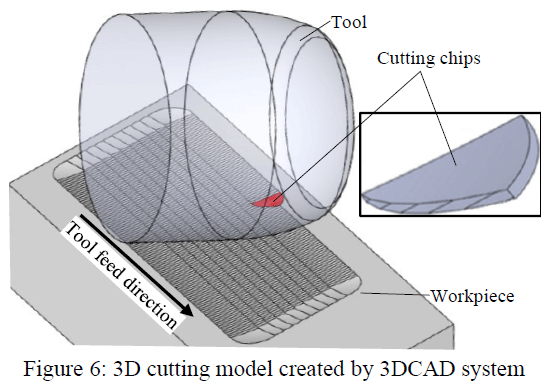
In recent years, various variant shape tools have been developed to achieve high-efficiency machining. In five-axis controlled machining, it is known that the tool posture affects the surface quality of the machined surface, but this has not been sufficiently investigated in the relation to machining with variant shape tools. Due to their unique cutting edges geometry, variant shape tools have more restrictions on the tilt angle than conventional tools. In this study, we focused on the lead angle with relatively high flexibility, and conducted cutting experiments using a barrel end mill, which is a type of variant shape tool. The results of the experiment confirmed that the surface appearance and the variation of chip length change in accordance with the lead angle. Furthermore, as a result of investigating the geometric changes in the cutting form using 3D CAD, it was confirmed that the changes in the lead angle alters the positional relationship between the disengagement point of the cutting edge and the area where the final machined surface is formed, and that this affects the surface appearance and the chip shape.
 http://www.ims.mce.uec.ac.jp/
Last updated on April 10, 2026 by
www-admin@ims.mce.uec.ac.jp
http://www.ims.mce.uec.ac.jp/
Last updated on April 10, 2026 by
www-admin@ims.mce.uec.ac.jp